Fagus grandifolia



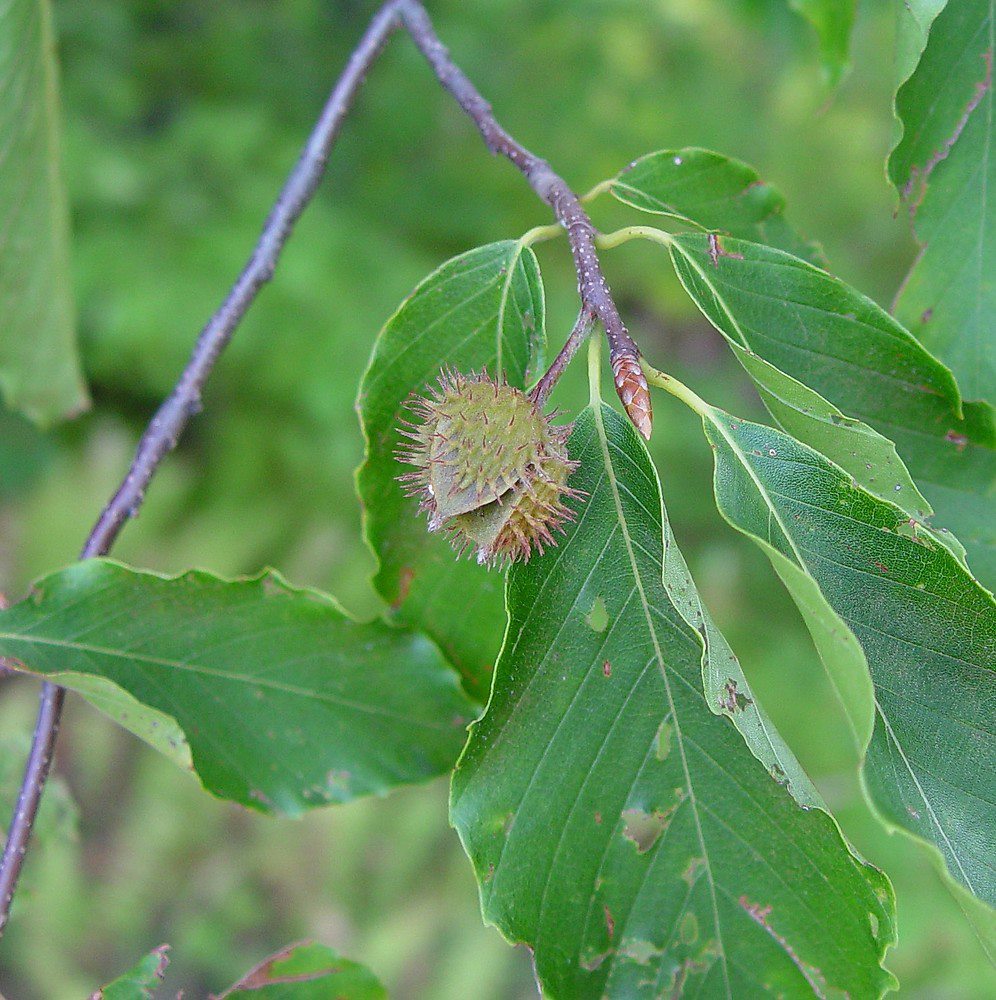
American Beech
The American beech, North America’s only native species of beech, can be easily recognized by its uniquely smooth, light gray bark. Another common identifier is that even though this is a deciduous tree, young trees tend to hold on to some or all of their coppery-yellow dead leaves throughout the winter due to a phenomenon called Marcescence.
American beech is considered among the most important food sources for native wildlife, bearing sweet beechnuts that are also edible for humans in addition to being a fan-favorite for a variety of animal species. These small, triangular nuts grow inside spiny burrs and can be eaten raw or cooked, or even roasted and ground into a coffee substitute.
The following identification information is from Trees of Alabama, a Gosse Nature Guide by Lisa J. Samuelson. Use of this text was permitted by the University of Alabama. Order your own copy of this great guide to Alabama’s trees here: https://www.amazon.com/Trees-Alabama-Gosse-Nature-Guides/dp/0817359419
American Beech Fagus grandifolia Ehrh.
COMMON NAMES American beech, beechnut tree
QUICK GUIDE Leaves alternate, simple, elliptical, each lateral vein ending at a margin tooth; buds large, long-pointed, cigarlike; fruit a triangular nut, with usually two enclosed in a weakly spiny bur; bark smooth and blue-gray.
DESCRIPTION Leaves are alternate, simple, deciduous, elliptical, and 8-13 cm (3.1-5.1 in) long, at first very thin and pubescent but become more leathery, shiny, and glabrous throughout the summer; lateral veins are parallel andeach vein ends at a margin tooth; apex is acuminate to rounded; base is obtuse; margin is sharply serrate; autumn color is orange-yellow, and dead leaves persist throughout the winter. Twigs zigzag and are slender, yellow-brown to red-brown, and glabrous, with lenticels; leaf scar is crescent shaped to half-round with three or more bundle scars. The terminal bud is cigarlike, up to 2.5 cm (1 in) long, and long-pointed; scales overlap and are shiny and yellow-brown to red-brown. Flowers are imperfect and bloom in the spring with the leaves; staminate flowers grow in heads and are long-stalked and drooping; pistillate spikes are much smaller and grow in the leaf axils at the shoot tip. Fruit is a nut, about 1.5 cm (0.6 in) long, triangular, and sweet and matures in the fall. Usually two nuts are enclosed in a woody and weakly spiny bur. Bark is blue-gray, thin, and smooth. The growth form is up to 30 m (100 ft) in height and 1.3 m (4 ft) in diameter with a low, wide crown.
HABITAT Fertile, moist, loamy soils of bottomlands, coves, stream edges, and north-facing slopes.
NOTES American beech is a shade-tolerant, long-lived tree found growing with red maple, sugar maple, black cherry, tulip-poplar, southern magnolia, sweetbay magnolia, eastern white pine, many mesic site oak species, basswood, and American elm. The wood is yellow-brown, heavy, and hard with tyloses in the heartwood and distinct growth rings. It is used for furniture (chairs in particular), veneer, flooring, tool handles, boxes, and turnery. The nuts are relished by wild turkey, foxes, wood duck, numerous songbirds, black bear, squirrels, and various other small mammals. This tree would be even more valuable to wildlife, but it has frequent seed crop failures.
Fagus is Latin for “beech tree,” which comes from a Greek word for “to eat”; grandifolia means “large leaved.”
 Friends of Pinchgut Creek