Quercus alba


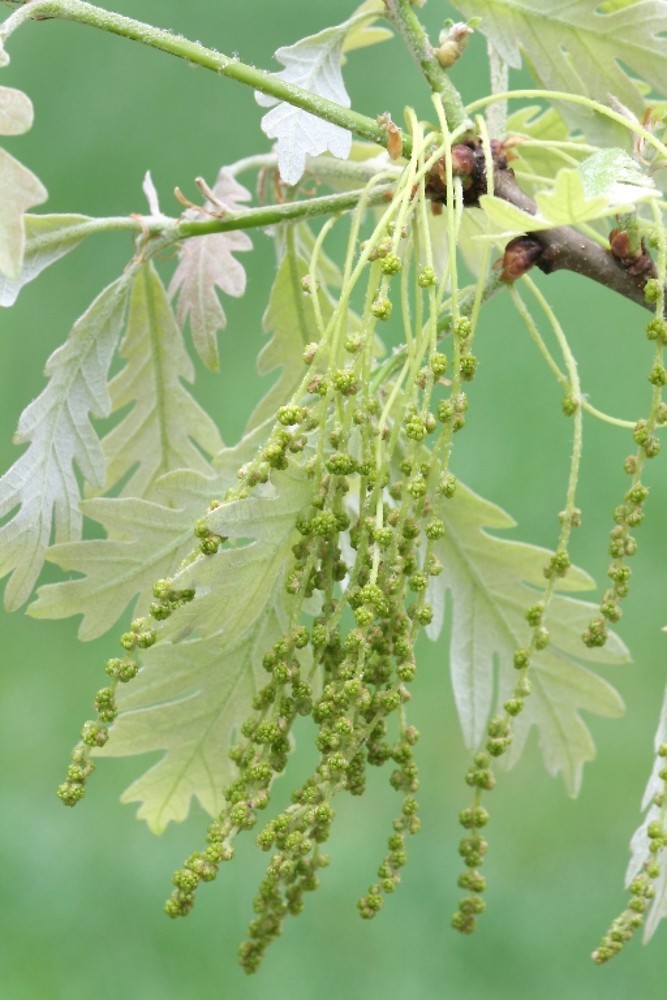

White Oak
Another common name for the white oak is “stave oak,” in reference to its leak-resistant wood which is used as barrel staves for aging whiskey and wine. In fact, federal regulation states that bourbon whiskey must be aged in charred, new oak barrels – specifically understood to mean American white oak. These trees are considered the most important lumber tree of the white oak group, having the ability to grow in almost any condition save the driest and most shallow soils. Its acorns, which are less bitter than that of the red oak, feed more than 180 different species of wildlife.
White oaks are long-lived trees, known to live 200-300 years, with the oldest recorded white oak – affectionately named “Wye Oak” in reference to its home in Wye Mills, Maryland – being estimated to have lived over 450 years before falling during a thunderstorm in 2002.
The wood of the white oak is also known to be used for crafting Japanese martial arts weaponry, and is used by Deering Banjo Company to make several models of five-string banjos, including their 40th Anniversary limited-edition banjo.

The following identification information is from Trees of Alabama, a Gosse Nature Guide by Lisa J. Samuelson. Use of this text was permitted by the University of Alabama. Order your own copy of this great guide to Alabama’s trees here: https://www.amazon.com/Trees-Alabama-Gosse-Nature-Guides/dp/0817359419
White Oak Quercus alba L.
COMMON NAMES white oak, stave oak
QUICK GUIDE Leaves alternate, simple, with seven to nine rounded and bristleless lobes; acorn cap knobby; bark gray-white, loosely plated or scaly.
DESCRIPTION Leaves are alternate, simple, deciduous, and 10-18 cm (3.9-7.1 in) long, with seven to nine rounded and bristleless lobes; apex is rounded; sinuses extend halfway or almost to the midrib; base is cuneate; underside is pale and glabrous or glaucous; autumn color is dull red or orange-yellow. Twigs are moderately stout, red-brown, and glabrous when young; leaf scar is crescent shaped to oval with numerous bundle scars. Terminal buds are about 4 mm (0.2 in) long and ovoid to round; scales are overlapping, red-brown, and mostly glabrous. Flowers are imperfect and appear in the spring with the leaves; staminate flowers are in drooping catkins; pistillate spikes are in leaf axils. Fruit is an acorn, 2-3 cm (0.8-1.2 in) long; nut is shiny and yellow to light brown; cap is bowl shaped with knobby, glabrous scales covering one-fourth to one-third of the nut; fruit matures in one season. Bark is gray-white to gray-brown and shallowly grooved, with small rectangular scales or large loose plates; bark becomes deeply grooved at the base of large trees. The growth form is commonly 30 m (100 ft) in height and 1.3 m (4 ft) in diameter.
HABITAT A variety of sites, including ridges, coves, sandy plains, dry slopes, and bottomlands.
NOTES Forest associates of white oak are numerous and site dependent. “White oak lumber” is yellow-brown, heavy, and hard, with tyloses, and is an important commercial wood used for flooring, furniture, trim work, and staves for barrels. The bark was used in tanneries. White oak is a nice landscape tree for large spaces because of its bark, foliage, and form. Acorns of all oaks rank at the top of wildlife food plants because of their wide distribution, availability, and palatability, and are considered the staff of life for many wildlife species. Acorns of the white oak group are generally preferred over the red oak group because of lower tannic acid levels. Smaller birds and mammals prefer the species producing the smaller acorns, whereas larger birds and mammals will eat all sizes, including the largest. A partial list of acorn eaters include mallard, black, pintail, and wood ducks; northern bobwhite; wild turkey; flying fox, and gray squirrels; all species of deer; black bear; peccary; raccoon; numerous songbirds; and many small mammals.
Quercus is Latin for “oak tree”; alba means “white,” perhaps referring to the bark or underside of leaves.
 Friends of Pinchgut Creek